| Basic Specifications |
| Resolution: | 12.40 Megapixels |
| Kit Lens: | Non-Zoom
9mm
(47mm eq.) |
| Viewfinder: | LCD |
| LCD Size: | 3.0 inch |
| ISO: | 125-6400 |
| Shutter: | 30-1/2000 |
| Max Aperture: | 1.9 |
| Dimensions: | 3.9 x 2.3 x 1.2 in.
(98 x 58 x 31 mm) |
| Weight: | 8.3 oz (235 g)
includes batteries, kit lens |
| MSRP: | $799 |
| Availability: | 09/2011 |
Pentax Q
No price data available. Check back soon.
too
small for the average user.
Pros: Interchangeable lenses that are also light and compact. Very small size that's easy to take anywhere. Still has physical controls where other companies seeking small designs have opted for other solutions with a steeper learning curve.
Cons: Small buttons and small size might be too hard to use for some. Image quality is bound to trail other compact system cameras, especially low light shots.
Price and Availability: Initially, the PENTAX Q system will ship in Japan. Anticipated shipping time to the United States is early Fall 2011 at around $800 for the standard lens kit.
Bloggers/Press: Click for Pentax Q images to use in your posts.
Pentax Q Hands-on Preview
by Shawn Barnett, Mike Tomkins, and Zig Weidelich
Posted June 23, 2011
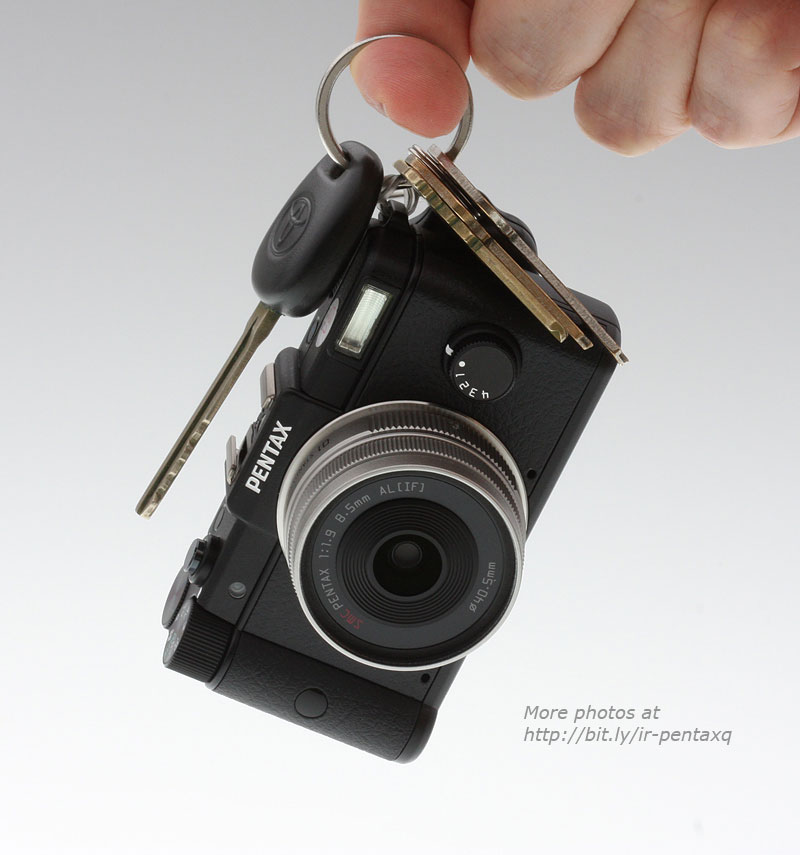
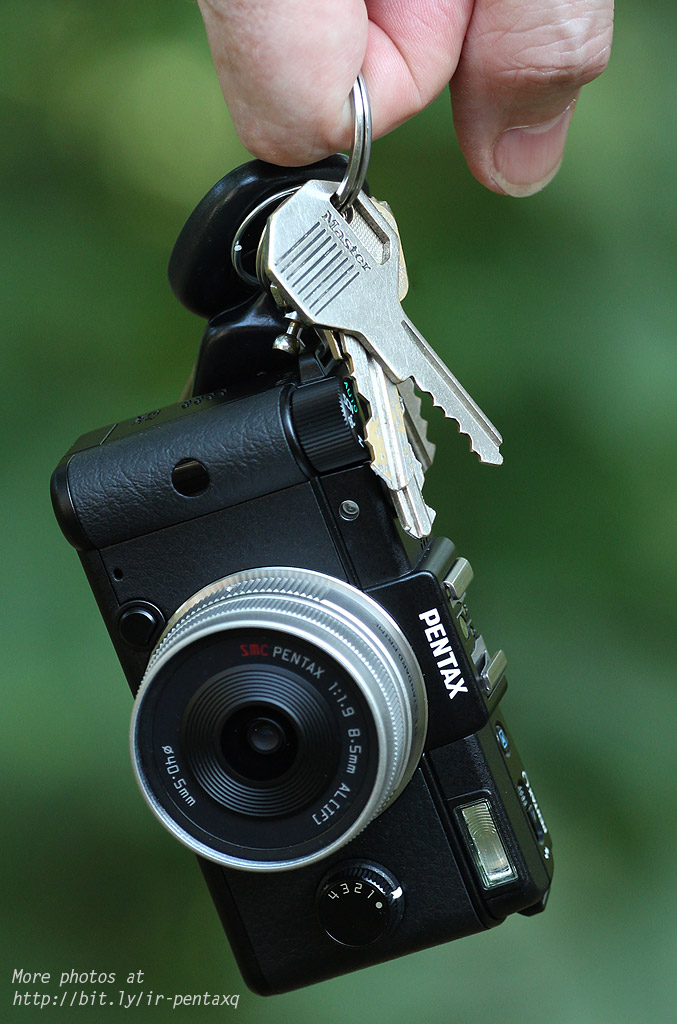
It wasn't long ago I had the pleasure of running around town with one of the largest interchangeable lens cameras on the market, the Pentax 645D. It was big, but handled well, with excellent optics and a very high-resolution sensor. Today the contrast was dramatic, carrying the very tiny Pentax Q, a small interchangeable lens camera. The experience was very different, but it was still a Pentax, a company that's pushing beyond lots of boundaries lately. The Pentax Q has smaller optics and a smaller, lower-resolution sensor. Indeed, it's so small it fits in a pocket and conceals easily in a palm--or behind an iPhone. It could even hang--as our illustration demonstrates--from a keychain, were it not worthy of better daily care than that.

Although we don't expect a 1/2.3"-sized sensor to compete with comparably priced SLRs and CSCs, we're impressed with the execution on the Pentax Q, and see signs that it will likely rival quality enthusiast cameras like the Canon G12, albeit at a $300 price premium for the luxury of interchangeable lenses.
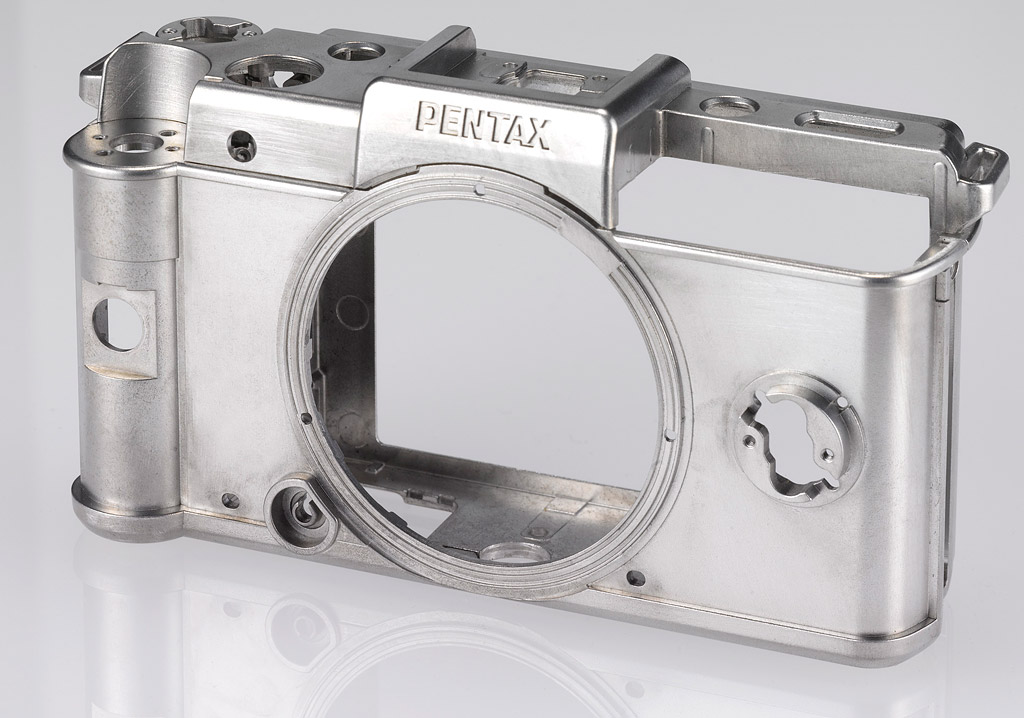
Build. With all of its latest digital SLRs, Pentax has demonstrated its ability to build a high quality camera, and the Pentax Q's magnesium alloy build feels more serious than a simple pocket camera, despite its Lilliputian stature. Pentax's impressive line of Limited SLR lenses, in particular, seem to be echoed in the quality of the 8.5mm Standard Prime kit lens as well. Both the lens and mount are steel and have a tight, precision fit.
Dials and buttons, too, are of good quality, with firm detents on the dials, and audible, tactile clicks on the buttons: an important feature with such small buttons.
Most surprising is how natural it feels to use the Pentax Q. It's smaller than the average pocket long zoom, but still feels about like using one, thanks to the small finger and thumb grip. In something of an optical illusion, the lens seems to be closer to the grip side of the camera than the other, but it's actually about two millimeters to the right.
Ultimately, the Pentax Q is built more like an SLR, but it feels as familiar as a quality pocket camera.

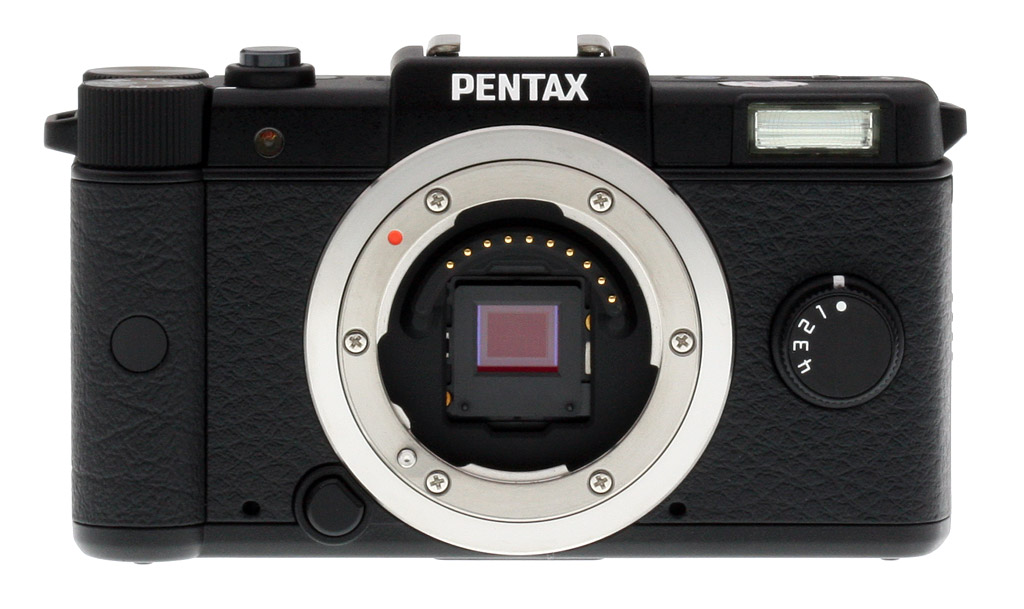
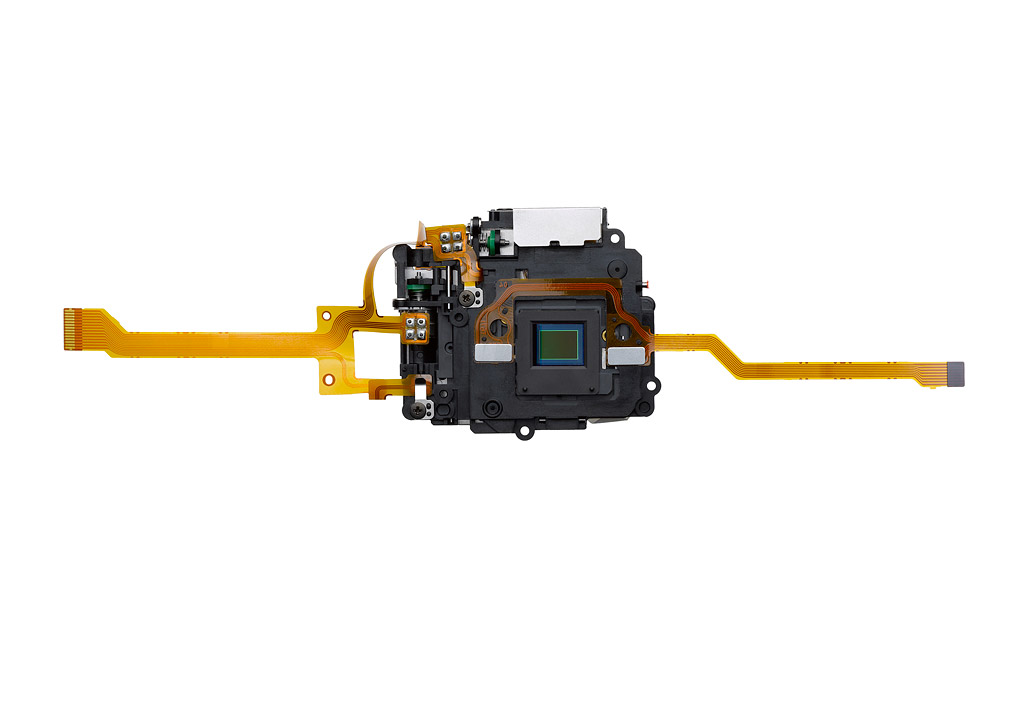
With the lens off, you can see the small sensor that allows such a small camera and such small lenses. It's somewhat surprising Pentax didn't choose a 1/1.7" sensor, as are used in the Canon G12 and competing designs. But the 12.4-megapixel CMOS sensor is backlit, which should offer better performance in low light, and lower noise overall.
The front view of the Pentax Q shows an IR remote sensor embedded into the grip, an AF-assist lamp, the lens release button, and two holes for the stereo microphones. The peculiar dial on the right of the lens is used to quickly select among a selection of Smart Effects or other available filters. Via a menu, you pick which filters you want to have at each setting; returning the dial to the white dot turns all filters off.
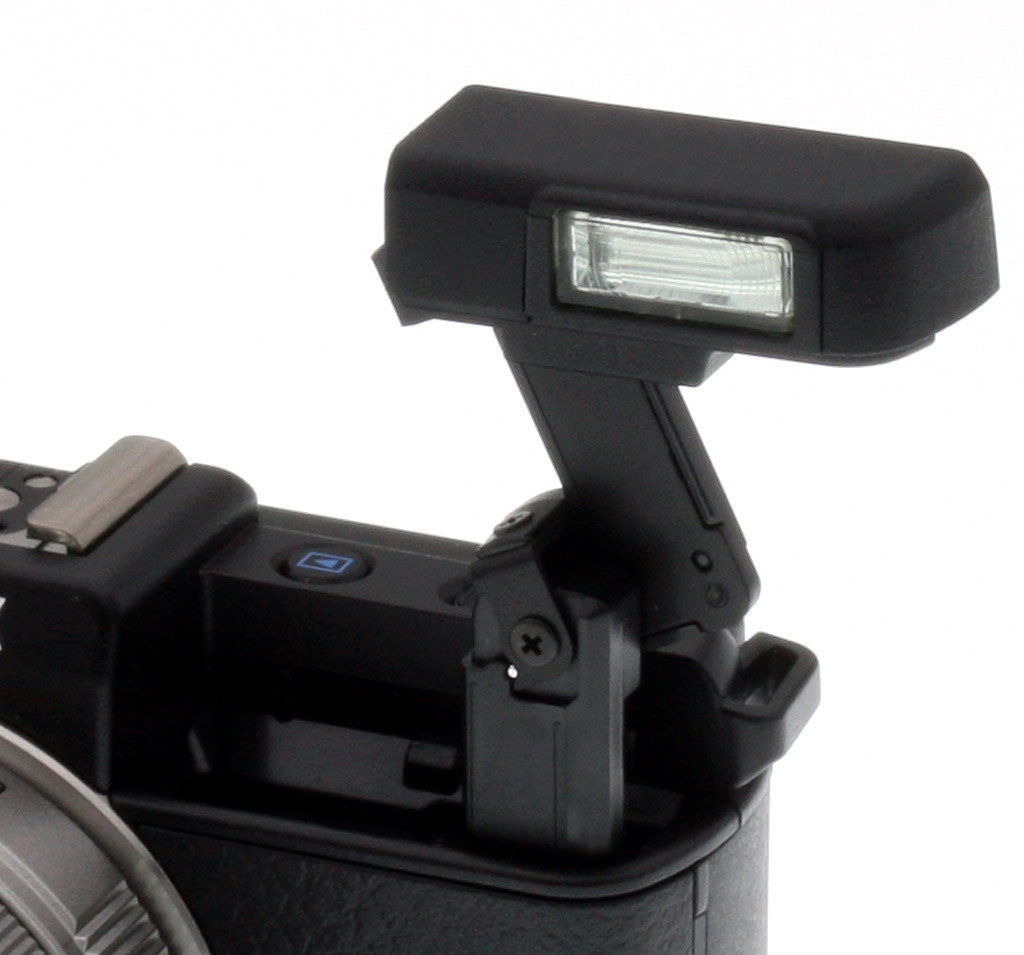
Though the flash looks like any other built into a pocket camera, it is anything but ordinary. It doesn't just pop up, it swings up and over to the right (see photo below) to help minimize red-eye and to clear larger lenses and lens hoods. Someone deserves an award for this bit of engineering. Here's hoping Pentax makes a wad of cash licensing the design to other companies. The flash will also fire from its nested position.

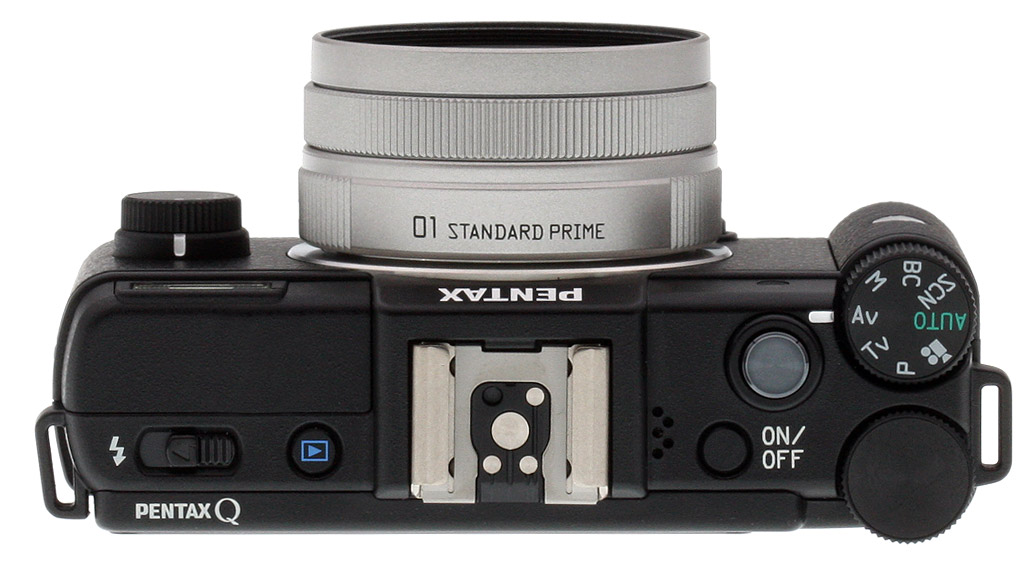
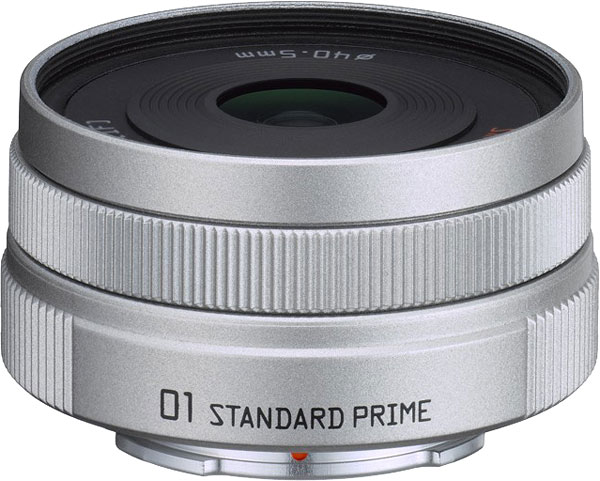
A look at the top of the Pentax Q shows the 8.5mm lens (47mm equivalent), called the 01 Standard Prime. Its knurled ring makes mounting and removal easy, and the front focus ring does not offer physical control over focus, instead feeding ring position data to the focusing system as you turn it. Our attempts with the prerelease model were actually pretty impressive, as the focus tracked the ring's movement very well, unlike many competing designs.
The small popup flash is released via the slider just behind it. It takes a little practice to release the flash without your fingers getting in the way. Next to that is the Playback button, something we'd have preferred to see on the back, but admittedly there's very little room on the Pentax Q. The hot shoe looks relatively massive on the Q, compatible with Pentax's current line of flashes, however large. Five holes mark the position of the speaker. The small power button is right of that, and the gunmetal shutter button rises fairly high from the camera body, offering a very soft half-press with a clean break at full press for a very good feel.
The Mode dial sits atop and dictates the shape of the small fingertip grip, just as the Rear dial describes the shape of the rear thumbgrip. Strap lugs are molded into the top plate of the Pentax Q, presumably also of magnesium alloy.

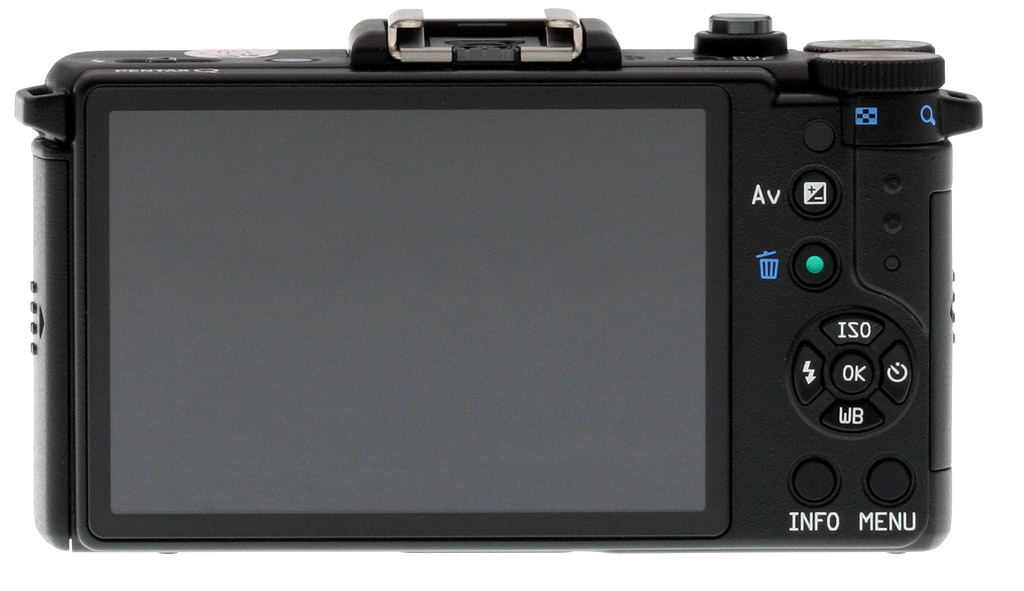
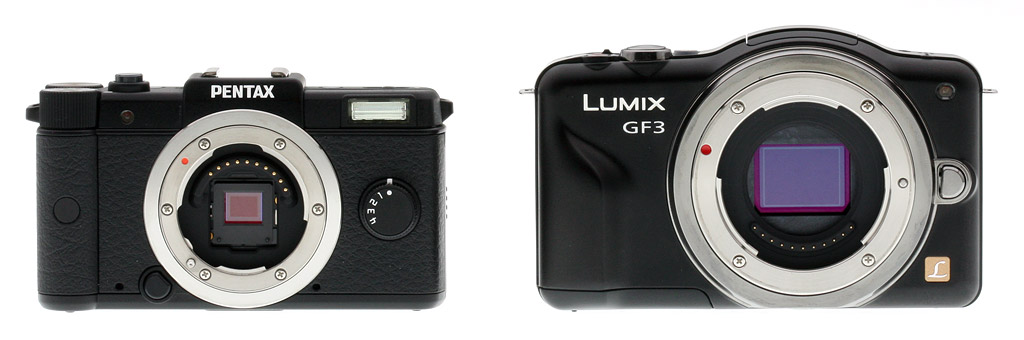
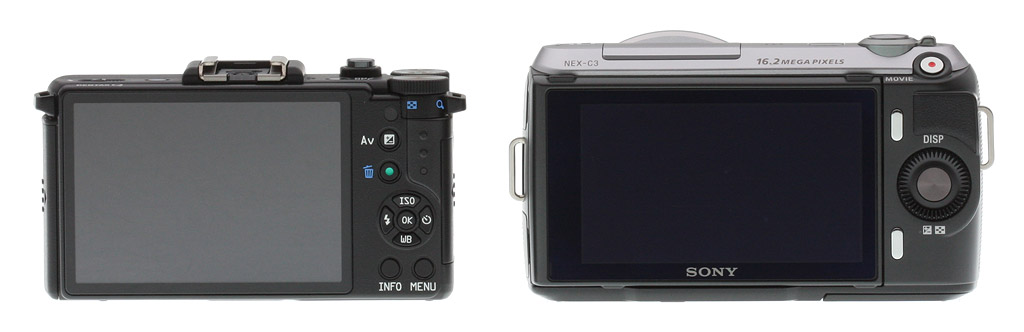
Tightly fitted into the small chassis is the 460,000-dot, 3-inch TFT LCD with a 170 degree viewing angle. Unlike the Sony NEX-C3 and Panasonic GF3, two cameras also pushing the size barriers for interchangeable lens cameras, the Pentax Q doesn't take the minimalist approach to the camera's interface to eliminate buttons. Instead they take the approach that's worked for pocket digital cameras for years: small buttons; no scroll wheels, soft buttons, or touchscreens. I can see some objecting to the use of such small buttons, but those who don't like small buttons have no business looking at a camera this small to begin with. Most of the buttons are recessed and stiff enough to avoid accidental activation, yet they yield to gentle, inward pressure with a soft click. The four outer navigation buttons are beveled upward from the center out for easier tactile differentiation from the other buttons, which are admittedly quite close.

Magnesium alloy. The Pentax Q feels very solid thanks to its magnesium alloy body.
Most of the buttons are marked, and so self-explanatory. The markings are small enough that those with poor near vision might have trouble, but they would also have trouble with the interfaces on the C3 and GF3, so I think Pentax has made a good choice here. Just above the Exposure Compensation button is a secondary IR remote port, according to Pentax (we received no remote with the prerelease camera, so we've no way to test it at this point).
It's when I look at the cavities necessary to house the battery, memory card, pop-up flash, and sensor that I marvel at the electronic engineering required to pack the circuit boards and processors into such a small remaining space. Internal space is further constrained by buttons, dials, the LCD, ports, and even the tripod mount. It is an impressive achievement, even if the sensor is quite small.
Getting back to that pop-up flash, it is a bit of a marvel itself, demonstrating that there is a way to get built-in flashes a little further from the lens through the application of clever engineering. First, with a slide of the mechanical release, a springloaded plunger rises from inside the Pentax Q's body, then opposing sprung levers both lift the flash and level it again in its final resting position. A simple downward press puts all back into place, quite well concealed and compact.
Size and Weight. Dimensions are 3.9 x 2.3 x 1.2 inches (98 x 58 x 31mm). Weight with a memory card, battery, and lens is 8.2 ounces (235g), and 7 ounces (198g) with the lens removed. That makes the lens 1.3 ounces (36.8g) light, at least a partial answer to the question of why you'd make an interchangeable lens camera with so small a sensor.
Connectivity. The Pentax Q includes USB 2.0 High Speed data connectivity, as well as both NTSC / PAL composite standard definition video output, and a Type-D Micro HDMI high definition output; both of these are accessed via a small rubber door on the bottom of the camera. Impressively, given the size, the Pentax Q also includes infrared remote control receivers on both the front and rear of the camera, ensuring the remote works whether you're behind the camera or in front of it.
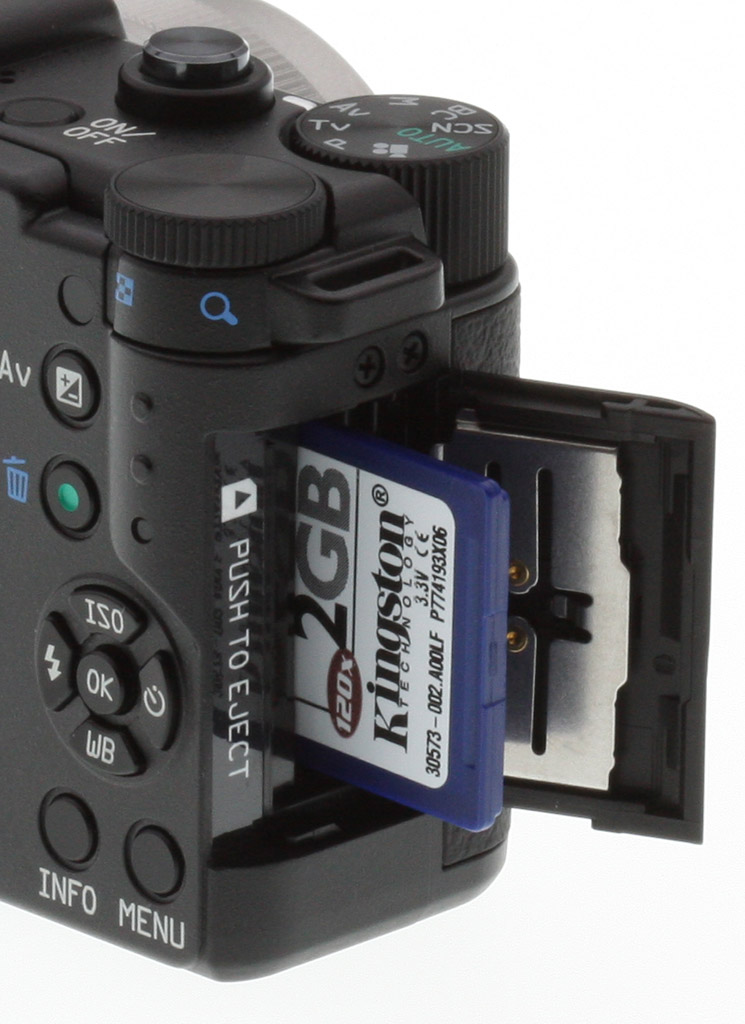
Storage. The Pentax Q accepts Secure Digital storage media, including the newer, higher capacity SDHC and SDXC types. Images are stored as 12-bit .DNG Raw files, or 8-bit JPEGs in one of three quality levels. Movies are stored as .MP4 files. The door is released with a slide to the rear, after which it swings open toward the front of the camera under spring pressure.
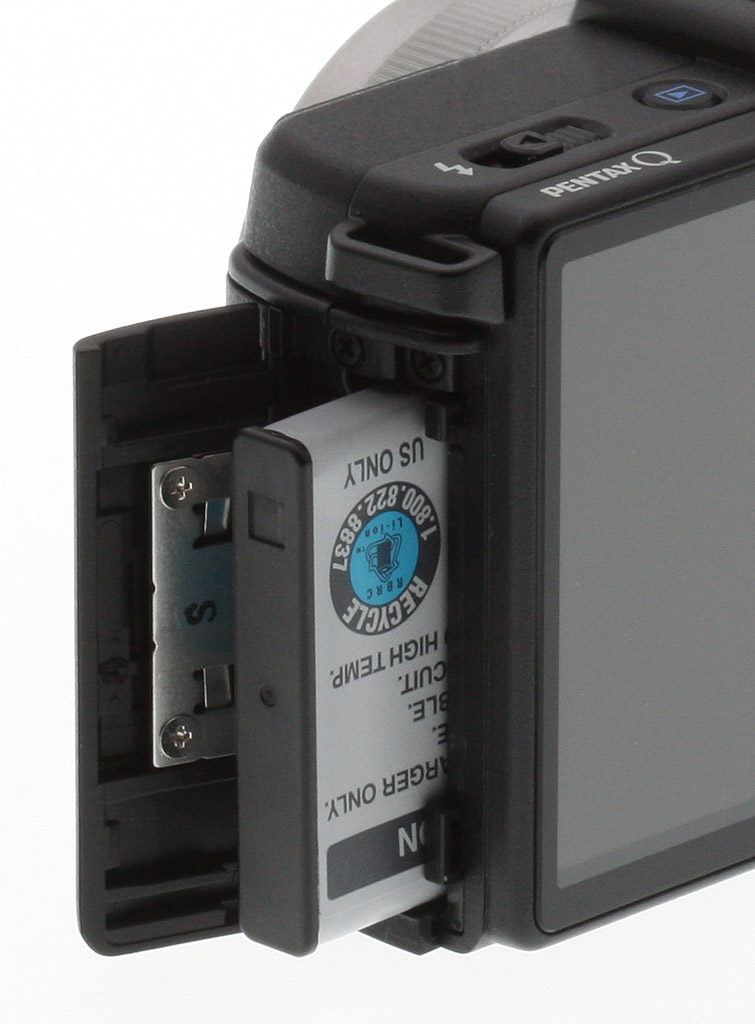
Power. A proprietary D-LI68 lithium-ion rechargeable battery allows the Pentax Q to provide for 230 shots on a charge, to CIPA testing standards (50% flash usage), or 160 minutes of continuous playback. This door also opens with a firm pull to the rear, followed by a springloaded swing toward the front.
Pentax Q Technical Details
Sensor. The modest size of Pentax's Q compact system camera has been achieved largely thanks to Pentax's choice of a 1/2.3"-type image sensor, where the company's main rivals have all chosen to use significantly larger sensors in their interchangeable-lens models. Compared to a Micro Four Thirds camera, the Pentax Q's imager has just slightly less than 1/8th the light gathering area, while APS-C models have an advantage of closer to 13x.

That decision is likely to prove something of a double-edged sword. On the one hand, it has allowed Pentax to craft a camera which it can confidently claim to be the world's smallest, lightest interchangeable-lens digital camera body. On the other hand, all other things being equal it also leaves the Pentax Q unlikely to challenge its compact system camera rivals in terms of high ISO noise performance, and nor can it rely on lens aperture control to provide the same shallow depth of field for creative effect. There's certainly something to be said for the importance of size and weight in camera design, though. If your camera gets left behind when you're out and about, the best image quality in the world is of little use when an unanticipated photo opportunity presents itself.
Aiming to achieve the best high ISO noise performance possible with its chosen sensor size, Pentax has selected a backside-illuminated, 12.4 effective megapixel CMOS image sensor for the Q. The backside-illuminated design places circuitry on the rear (non-illuminated) side of the sensor, allowing the greatest possible area on the light-gathering side to be devoted to photodiodes. Total resolution of the Pentax Q's chip is 12.75 megapixels, and the maximum dimensions of output images are 4,000 x 3,000 pixels. The sensor has a 4:3 aspect ratio, and the Pentax Q also offers cropped 3:2, 16:9 and 1:1 aspect modes. ISO sensitivity ranges from 125 to 6,400 equivalents in 1/3 EV steps, and can be controlled automatically or manually throughout the entire range.
Lens mount. Accompanying the Pentax Q's image sensor is a new stainless steel lens mount that's significantly smaller than the K-mount used on Pentax's digital SLR cameras. Dubbed the Q-mount, this has an outer diameter that's almost one-third smaller than that of the K-mount, allowing a reduction not only in camera body size, but also in the size of attached lenses. Like other compact system cameras, with no need to accommodate a bulky mirror box, optical viewfinder, dedicated autofocus and metering sensors, etc., Pentax has been able to reduce flange back distance--which relates closely to body thickness--by a whopping margin of close to 80%. Flange back distance for the Pentax Q is just 9.2mm, less than half that of the Sony E-mount (18mm), Micro Four Thirds mount (20mm), and Samsung NX mount (25.5mm).
As an aside, there's an interesting back story behind the names of Pentax's lens mounts. With the introduction of the K2, KX and KM film cameras in 1975, the company--then known as Asahi Pentax--decided to replace its venerable M42 screwmount with a newer, easier-to-use bayonet type. Dubbed the K-mount, the new mount's initial stood for "King"--an indication of Asahi's belief in their product which also happened to dovetail nicely with their marketing efforts. (At the time, the Asahi Pentax logo included a crown, while their cameras appeared in advertisements alongside a deck of playing cards, with a king card shown prominently.) Every king needs his queen, and with the debut of the Pentax Q camera, the new Q-mount assumes that role.
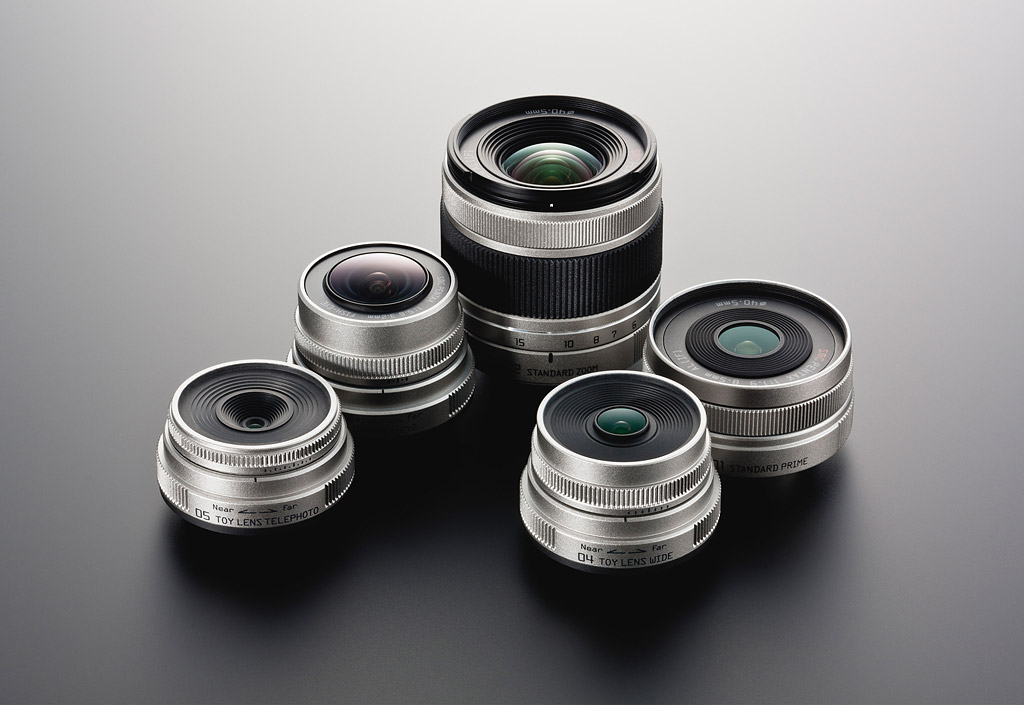
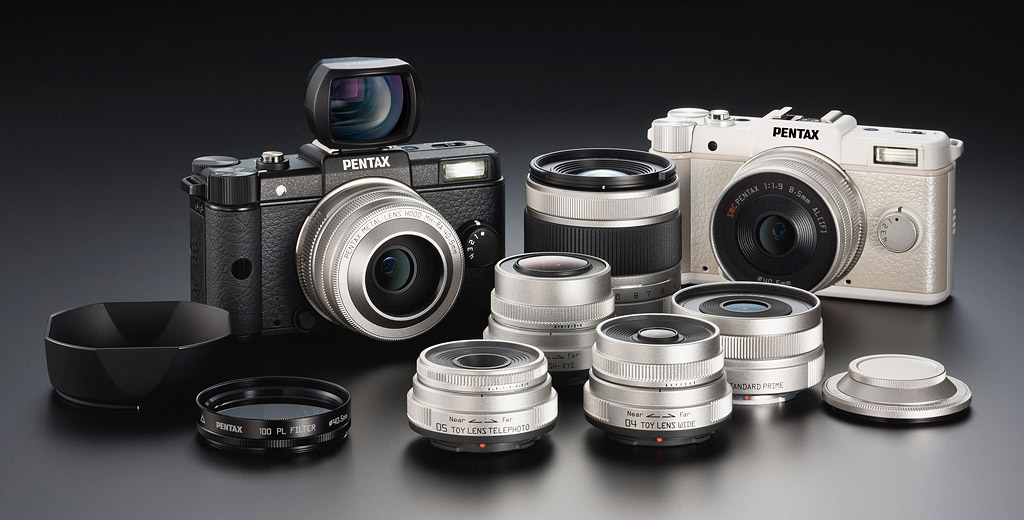
Optics. Alongside the camera's launch, Pentax has revealed its first five Q-mount lens models, split into two distinct groups, which Pentax Japan refers to as the "High-Performance Series" and "Unique Series" respectively. High Performance lenses feature metal mounts and Pentax's SP (Super Protect) lens coating, offer 40.5mm filter threads, and include both a built-in ND filter, and an in-lens shutter mechanism that allows 1/2,000 second flash sync with the internal flash. Unique-series lenses are aimed at lower cost, and replace the metal mount with a plastic one, much like the company's DA-L lenses on K-mount cameras. They also drop autofocus capability, the in-lens shutter mechanism and ND filter, don't include filter threads, and--with the sole exception of the Fish-Eye lens--don't feature the Pentax SP lens coating.
The High Performance series includes two lens models at launch. The PENTAX 01 Standard Prime kit lens-- which ships with the camera itself--has a 35mm-equivalent focal length of 47mm, and an f/1.9 maximum aperture. The sole zoom lens, and the only High Performance-series lens available for separate purchase at launch, is the PENTAX 02 Standard Zoom. This offers up a 35mm-equivalent focal length range of 27.5-83mm, with a maximum aperture that varies from f/2.8 to f/4.5 across the range.
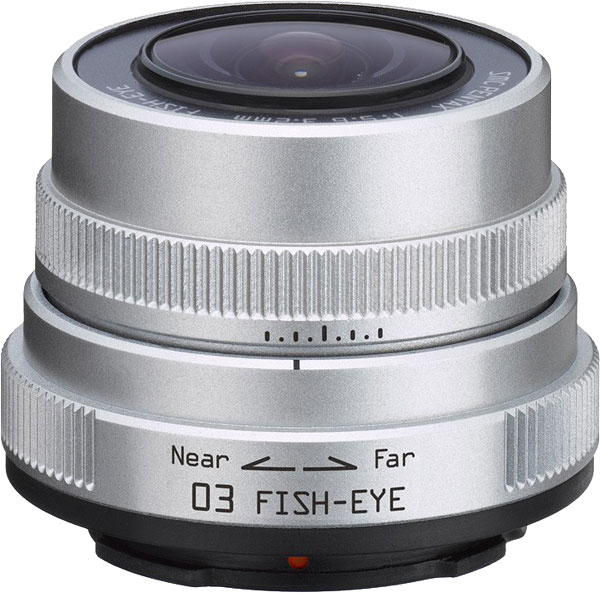
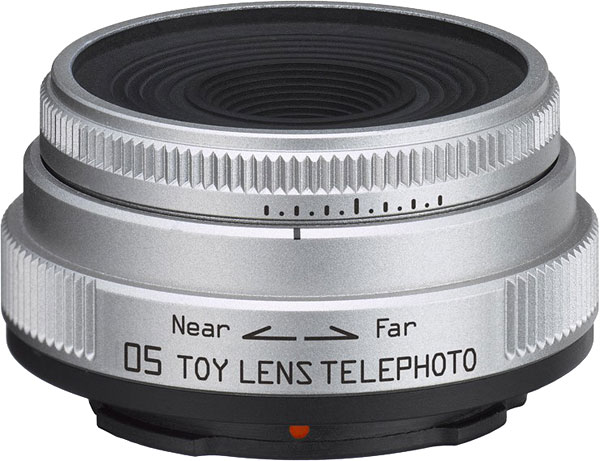
The Unique series lens lineup includes three models at launch, all of which are manual-focus only. The PENTAX 03 Fish-Eye is the sole model in the series to include an SP coating, and has a 17.5mm equivalent focal length, a 160° field of view, and a pan-focus design. The remaining two lenses are intended for creative use, and will likely appeal to fans of Lomo photography. Dubbed "toy lenses," the Pentax 04 Toy Lens Wide and Pentax 05 Toy Lens Telephoto equate to 35mm and 100mm lenses in the 35mm format, respectively, and each introduces various aberrations into final images.
Following are detailed specifications for all five Q-mount lenses that accompany the Pentax Q camera at launch.
| PENTAX-01
STANDARD
PRIME | PENTAX-02
STANDARD
ZOOM | PENTAX-03
FISH EYE | PENTAX-04
TOY LENS
WIDE | PENTAX-05
TOY LENS
TELEPHOTO |
|  |  |  |  |  |
| Series | High-Performance Series | Unique Series |
| Mount | PENTAX Q |
| Mount Material | Metal | Plastic |
| Flange Focal Length | 9.2mm |
| Lens Construction | 8 elements in 5 groups | 8 elements in 7 groups | 6 elements in 5 groups | 4 elements in 3 groups | 3 elements in 3 groups |
| Angle of View | 49.5° | 76.0° - 29.0° | 160° | 64° | 24.5° |
| Actual Focal Length | 8.5mm | 5mm - 15mm | 3.2mm | 6.3mm | 18mm |
| 35mm-equivalent Focal Length | 47mm | 27.5mm - 83.0mm | 17.5mm | 35mm | 100mm |
| Max. Aperture | F1.9 | F2.8 - F4.5 | F5.6 | F7.1 | F8 |
| Diaphragm Control | Automatic | Fixed |
| Lens Shutter | Yes | No |
| ND Filter | Yes | No |
| SP (Super Protect) Coating | Yes | No |
| Minimum Focusing Distance | 0.2m | 0.3m (all focal lengths) | 0.09m | 0.07m | 0.27m |
| Approx. Maximum Magnification | 0.05x | 0.06x | 0.06x | 0.15x | 0.08x |
| Filter Thread Diameter | 40.5mm | Not compatible |
| Maximum Diameter | 45.5mm | 48.5mm | 40.6mm | 40.6mm | 40.6mm |
| Minimum Length | 23.0mm | 48.0mm | 30.5mm | 25.0mm | 19.5mm |
| Approx. Weight | 37g | 96g | 29g | 21g | 18g |
| Hood | MH-RA 40.5mm
(optional) | PH-SBA 40.5mm
(optional) | Not compatible |

Despite the huge reduction in body and mount size compared to its K-mount cameras, Pentax has still left sufficient room within the Q-mount's image circle to allow for it to include its sensor shift image stabilization mechanism. Like that used in its SLRs, the Pentax Q's Shake Reduction system is said to be good for a four-stop correction, and thanks to the in-body design, it's available for all Q-mount lenses.
Dust reduction. The Pentax Q also includes the company's DR II dust reduction system, similar to those used in its flagship K-5 / K-7 and 645D digital SLRs. Based around a piezoelectric element, this system represents a worthwhile step up in efficacy from the sensor shift-based systems used in many consumer DSLRs.
Performance. In its Continuous Hi-speed burst shooting mode, the Pentax Q can capture images at a swift five frames per second, although burst depth is limited to just five JPEG frames. By switching to the Continuous Lo drive mode, the burst speed falls to 1.5 frames per second, but the buffer depth can be extended to a much more useful 100 JPEG frames.
Display. On its rear panel, the Pentax Q offers up a roomy 3.0-inch LCD panel with a total resolution of some 460,000 dots, commonly known as HVGA (half VGA), where each pixel comprises adjacent red, green, and blue dots. The Pentax Q's display is said to offer wide 170-degree viewing angles both horizontally and vertically.
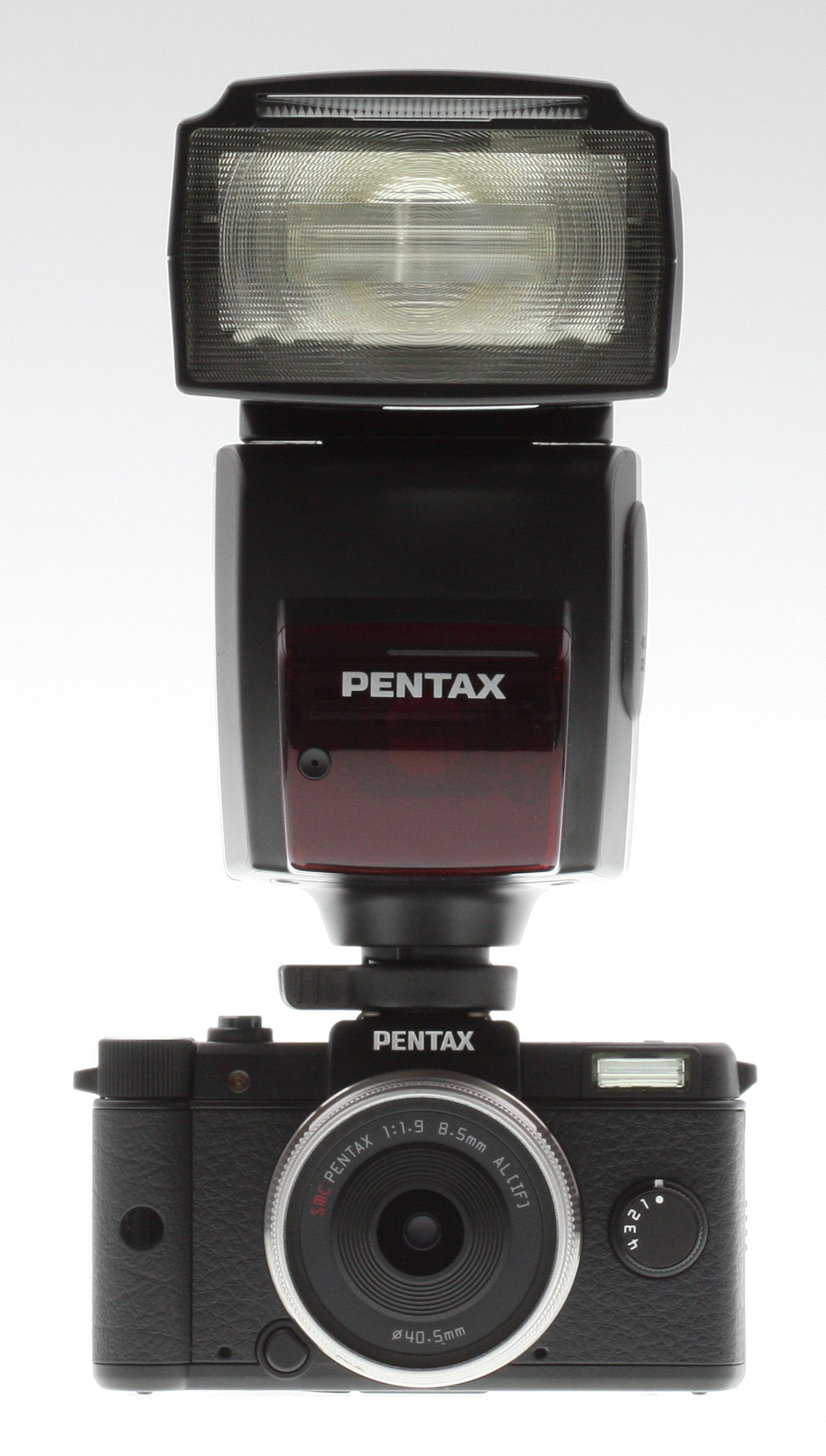
Viewfinder. The Pentax Q doesn't offer any form of built-in optical viewfinder, and unlike some compact system cameras, it can't accept an external electronic viewfinder either. Pentax does offer a shoe-mounted O-VF1 optical viewfinder accessory, but it only includes guide marks for the 47mm kit lens, and this combined with its $250 price tag will likely persuade many to instead rely solely on its LCD display.
Focusing. Like its main competitors, the Pentax Q uses contrast-detection autofocusing, operating on data streaming from the main image sensor. The Pentax Q's 25-point autofocus system has both single and continuous-servo operating modes, and includes a face detection function. Of course, it's also possible to focus manually if desired.
Exposure. As you'd expect, the Pentax Q includes the usual selection of Program, Aperture-priority, Shutter-priority, and Manual exposure modes. There's also an Auto Picture mode that can automatically select between Standard, Portrait, Landscape, Macro, Night Scene Portrait, Night Scene, Blue Sky, and Forest shooting modes as the camera deems appropriate. For those who want a modicum more control without the need to understand basic exposure variables, there's also a Scene mode that offers a healthy selection of modes: Portrait, Landscape, Macro, Moving Object, Night Scene Portrait, Sunset, Blue Sky, Night Scene, Night Snap, Food, Pet, Kids, Forest, Surf & Snow, Backlight Silhouette, Candlelight, Stage Lighting, Museum, plus three JPEG-only modes, Night Scene HDR, Quick Macro, and HDR.
Shutter speeds from 1/2,000 to 30 seconds are available, and are controlled with an in-lens shutter mechanism in the Pentax 01 Standard Prime and Pentax 02 Standard Zoom lenses. The Fish-Eye and Toy lenses all lack an in-lens shutter mechanism, and since the camera body itself doesn't include a shutter, this necessitates use of an electronic shutter when these lenses are attached. The Pentax Q also offers a bulb position in the Manual exposure mode, and this lowers the maximum sensitivity from ISO 6,400 to 1,600 equivalent. Three metering modes are available: Multi-segment (no info yet available on how many segments), Center-weighted and Spot. The Pentax Q offers 3.0 EV of exposure compensation, in 1/3 EV steps. There's also a three-frame bracketing mode, plus an exposure lock function which can be tied to either the Shutter or Green buttons.
Flash. The Pentax Q includes a built-in five-mode popup flash strobe with a guide number of 7 meters / 23 feet at ISO 200. As we mentioned, at first glance it looks to be fixed in place, but it actually includes an unusually tall articulation mechanism that allows coverage sufficient for a 28mm-equivalent wide angle lens. There's also a full-sized hot shoe compatible with all of Pentax's current flash strobes, although larger units are likely to prove rather unwieldy, when paired with the Pentax Q's impressively compact body. The internal flash provides a red-eye reduction function, and operating modes include Auto, Auto + Redeye, On, On + Redeye, Slow Sync, Slow Sync + Redeye, Trailing Curtain Sync, and Off.
When using the internal flash strobe, X-sync is possible at 1/2,000 second, but only if the attached lens includes an internal shutter mechanism -- something true only of the High Performance lens series. X-sync falls to 1/250 second with an external flash strobe, and plummets to just 1/13 second for Unique-series lenses that must rely on an electronic shutter. Flash exposure compensation is possible within a range of -2.0 to +1.0 EV.
HDR imaging. Like all of Pentax's recent DSLRs, the Pentax Q includes in-camera high dynamic range imaging, which automatically blends three shots in-camera to yield a single frame. As with the company's DSLR HDR mode, the Pentax Q can automatically microalign the source images, allowing the HDR mode to be used handheld.
Creative. A particularly unusual feature of the Pentax Q is its Smart Effect functionality, which offers up a selection of Brilliant Color, Unicolor Bold, Vintage Color, Cross Processing, Warm Fade, Tone Expansion, Bold Monochrome, Watercolor, and Vibrant Color Enhance effects. Each can be assigned to the dedicated front dial to provide five-step control (1-4 and Off) over the strength of the effect. Alternatively, the dial can be set to switch between user-selected effect types. There are also a variety of capture-time digital filter modes, as seen in past Pentax SLR cameras. These include Toy Camera, High Contrast, Shading, Slim, HDR, Invert Color, Extract Color, Color, Watercolor, Posterization, and Fisheye. Finally, a JPEG-only "Blur Control" mode attempts to simulate reduced depth of field, mimicking the look of images shot with larger-sensor cameras.
User modes. Pentax Q shooters can also store their favorite camera settings, filters, and custom image modes into one of three User modes, allowing quick recall of favorite settings useful in a specific shooting situation.
Video. As well as still images, the Pentax Q can capture 1,920 x 1,080 pixel high definition video (commonly called 1,080p or "Full HD") at a rate of 30 frames per second. If storage or bandwidth are more important than resolution, you can also select from high-def 1,280 x 720 pixel (720p) and standard-def 640 x 480 (VGA) at the same rate of 30 fps. Unlike Pentax's digital SLR cameras, the Q uses H.264 AVC compression, which is far more efficient in terms of storage space, albeit with a greater requirement in terms of processing power to edit the resulting video on a computer.
Pentax Q size comparisons
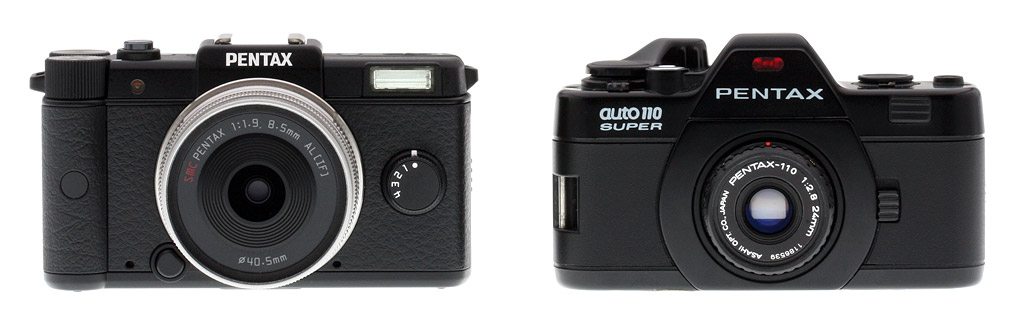
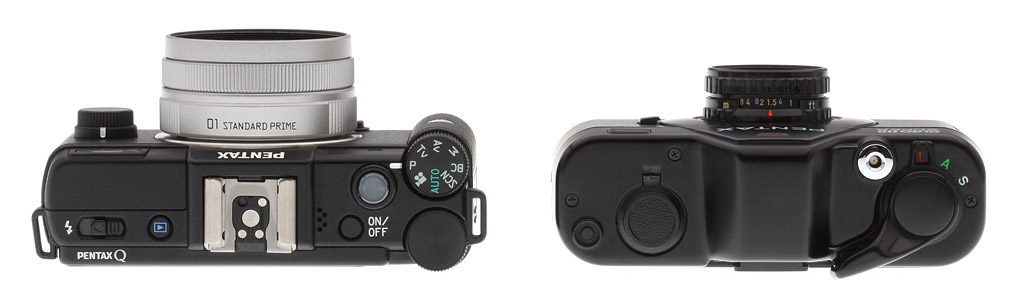
Pentax Q vs Pentax A110
 |
 |
 |
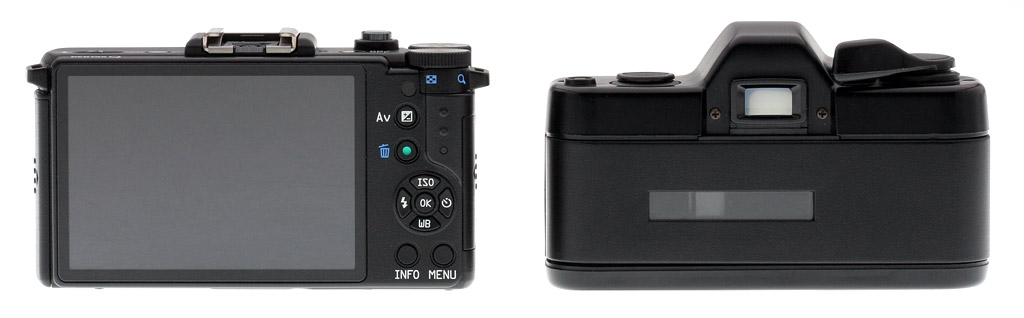
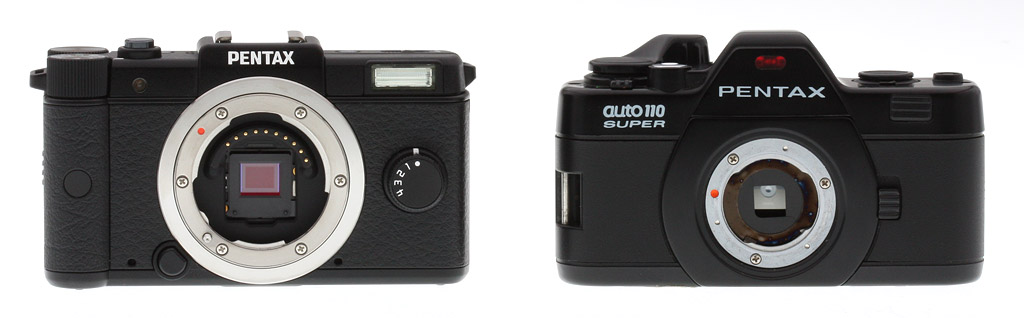
Arthur Etchells, IR's Director of Strategic Development, jumped in his time machine and acquired this pristine Pentax Auto 110 Super, circa 1982, for comparison with the Pentax Q. Its lens mount was even smaller, as the photos show. It was a true SLR, complete with pentaprism. Its relatively squat profile was allowed by the small stature of the 110 film cartridge, while the Pentax Q's size is dictated partially by the 3-inch LCD. The Auto 110 did not have a hot shoe, though it is less than a millimeter taller than the Pentax Q. |
 |
 |
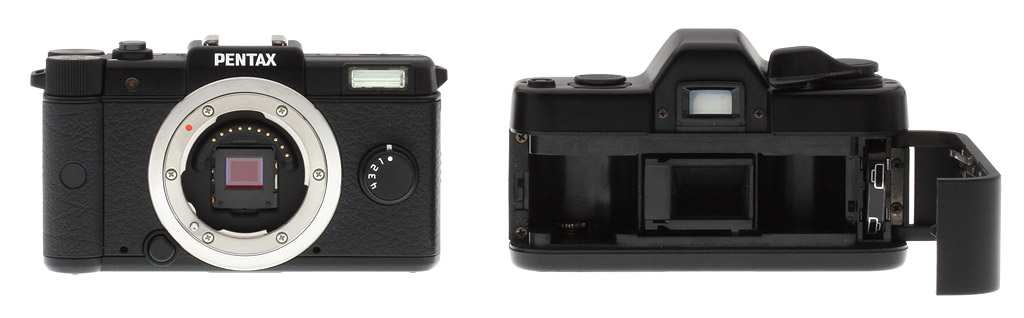
From the front with the lenses off, you get an even better idea of how small the Pentax Auto 110 Super's mount is. The two-bladed shutter inside the Auto 110's lens mount makes the film size seem smaller than it is. The Auto 110 was unusual in featuring a combined leaf shutter / aperture diaphragm in the camera body, while the corresponding lenses had a fixed f/2.8 aperture. Between exposures, the shutter / aperture mechanism was held partially open to allow image framing through its optical viewfinder, while the mirror beneath provided a light seal when lowered to prevent film exposure. An interesting side effect of this design was that full-aperture imaging was only available for exposures 1/30th second or longer. The view from the back with the film door open hence gives a better comparison of the Pentax Q's 1/2.3" sensor to the 110mm film size of the Pentax Auto 110. |
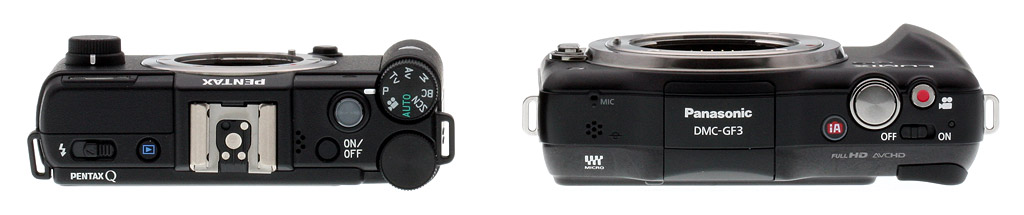
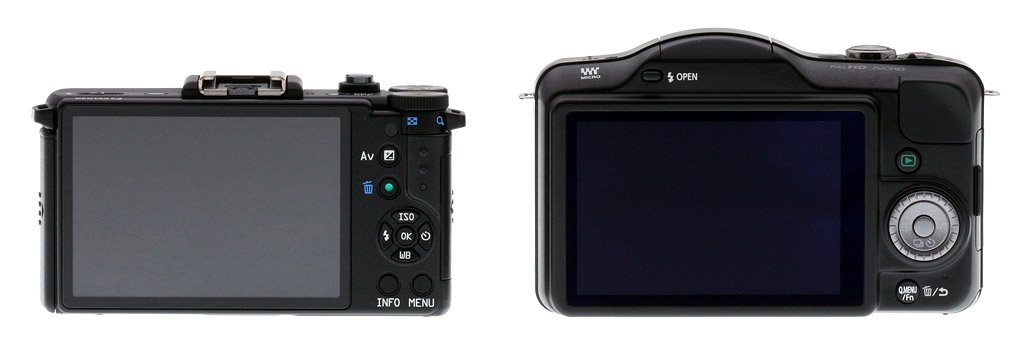
Pentax Q vs Panasonic GF3
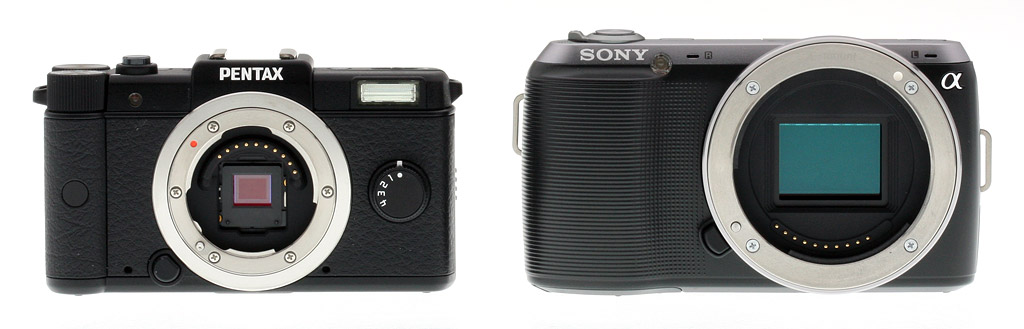
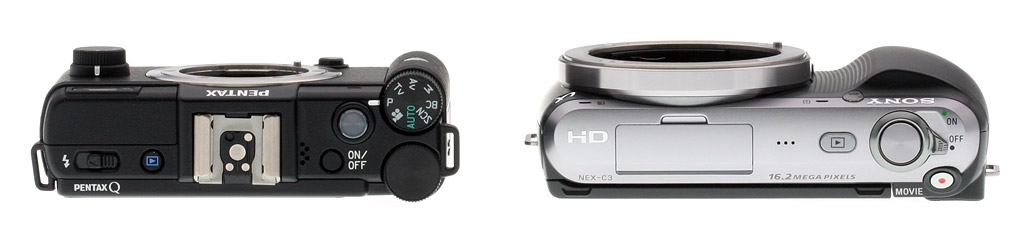
Pentax Q vs Sony NEX-C3
Shooting with the Pentax Q
by Shawn Barnett
Though it works well enough to get our preliminary lab shots, the prerelease Pentax Q we received for preview was still a little rough in its operation for reliable use in the field, so we'll have to confine our comments to the fit and basic utility of the Q.

As someone who's used to handling everything from the smallest pocket cameras to the largest pro SLRs, I have no problem adapting to the small size of the Pentax Q. Its small buttons are familiar and easy to use, with each working as I expect; indeed the buttons work better than some of the small cameras we review. Though my thumb rests on the AF and Green buttons, I didn't press any of them accidentally as I used the Pentax Q.
As it should be, the Mode dial is stiffer than the Jog dial in the back. Both are easy to access, but you want the Mode dial to stay put most of the time, while the rear dial should give to gentle pressure to allow quick settings changes and zooming in and out of photographs in Playback mode. Excellent design there, design that also looks cool.
I also found the front Quick dial to have potential. In addition to assigning Smart Effects to the four settings, you can choose to dial in Custom Image settings, Digital Filters, or choose among the four different aspect ratios: 16:9, 3:2, 4:3, and 1:1. The filters weren't working properly when I tried them, but changing aspect ratios was easy enough, showing the value of such a dial.
Lenses snick on and off of the Pentax Q just as they do on any other quality system camera with metal mounts, which is nice. I shouldn't say lenses, though, because we've only received the one 8.5mm lens, which I remove mostly to look again on that little sensor and incredibly short flange back distance (the space between the lens and sensor), and feel the quality of the mount's interface. In fact, there's nothing cheap feeling about the Pentax Q. It's all pretty solid and well-made. In the hand it feels rock solid, more so than any pocket camera of recent memory, even more than the Canon S90. The Pentax Q's magnesium alloy body is obviously the cause.
You don't really grip the Pentax Q, you pinch it gently between your two middle fingers and your thumb. For me, it rides high in my hand, with my right ring finger propping it up from underneath the front panel. It's very easy to shoot only one-handed, though of course we always recommend using two. That's fairly easy as well, thanks to the large open area for the left hand, though I did find my finger entering some of the shots when I was shooting with the camera turned vertically to the right. Bring two comparatively large hands together on a small camera and that'll happen now and then.

Of course the real story of using the Pentax Q is in how it performs, and I just can't talk about that having seen such an early unit. I managed to have fun with it, and there's no question it's a serious camera, complete with the Manual and semi-auto controls photographers prefer. Missing from the experience was actually switching lenses for various subjects, but the 47mm equivalent lens was sufficient, as I like shooting with one focal length. I was occasionally surprised, though, when subjects I've shot recently most often with 24 and 28mm lenses were more tightly framed, requiring that I step back. So few APS-C cameras offer the equivalent of a Normal lens, I'm just not used to shooting that way these days.
Discussion. Post-announcement, there were plenty of interesting comments and criticisms of the Pentax Q. The main point of contention: why they chose such a small sensor. I'd been wondering the same thing for months. (Anyone watching the rumor sites knows that the photos of what was called the Pentax NC-1 were circulating for several months, and while the name was not correct, the images were absolutely right.) I can't disagree with those who wouldn't want a small-sensor compact system camera for their purposes; for their purposes, they're right. But once I held the Pentax Q, all of that concern went away. I think it's mostly the build quality, as I've said, that changed my mind. My ultimate determination, of course, will come down to image quality. I'm all for toy lenses and creative photography if that's your thing, but at $800, a camera had better be able to take a crisp image when you need it to.
While I understand the criticism, I think it largely misses the point. Because the Pentax Q is properly described as a Compact System Camera, people automatically compare it to the existing Micro Four Thirds and APS-C competition on the market. In that comparison, though the Pentax Q is indeed smaller, its small sensor means that image quality is unlikely to rise to the level we've seen from these larger-sensor cameras. Point taken.

But at this size, the Pentax Q has another list of more relevant competitors, namely the Canon G12 and Nikon P7000, both quite a bit larger, and the Canon S95, and Panasonic LX5. A large number of professional and enthusiast photographers have decided that the tradeoff of a smaller sensor is worth it for the compactness and simplicity found in these otherwise serious camera designs. These four cameras have one point of potential superiority over the Pentax Q, that of sensor size. Three offer a 1/1.7" sensor, and the Panasonic's is 1/1.63", both of which are larger than the Q's 1/2.3" sensor. Their point of inferiority, though, is their reliance on built-in zoom lenses, which cannot be exchanged for lenses of different types or quality. This is the second compromise photographers make when shooting these high-end compacts, because zoom lenses almost always include flaws somewhere along their zoom range, and their motorized zoom mechanisms can be too slow and inaccurate when compared to the physical zoom rings on a CSC or SLR.
When compared to these cameras, the Pentax Q is smaller than any, and has the advantage of interchangeable lenses, some of which in theory could be of higher quality, with greater sharpness in the corners and less chromatic aberration (again, we won't be able to say this for sure without testing a shipping version). I do think the optics will need to show some prowess to be taken seriously, but I can't overstate the value of having a small system camera when you want to travel light, and this is the smallest of system cameras at this point. Traveling with a Micro Four Thirds camera, I can cover a lot greater focal range in a tiny space than I can with either of my APS-C SLRs; and the four high-end pocket cameras mentioned above also can't compete in zoom range. Pentax will need to ship a longer telephoto zoom to match what I get with an E-PL2 and a 14-150mm (28-300mm eq.) lens, but the potential is there, thanks to the Q-mount. And because of the smaller sensor, long focal-length Q-mount lenses will be much smaller than even Micro Four Thirds vendors will be able to produce.
The four high-end pocket cameras I mentioned range from $400 to $500, another point in their favor. But is $300 really that much more to gain the option to switch lenses? Certainly for some, but those enthusiasts out there buying accessory lenses, special brackets, and other multi-hundred dollar accessories to enhance their otherwise compact camera might not think so. The Pentax Q wasn't made for most people, even most enthusiasts, but it is made for some.
For most enthusiasts photography is a hobby. Some enthusiasts get so deep into the speeds and feeds they forget this, and are the first to decry a camera like the Pentax Q. That's fine, and part of the hobby, frankly: comparing, measuring, ranting, and ultimately preferring this or that. We cater to them, happily so. But I'd like to remind enthusiasts like myself that it is a hobby, and if we're not having fun, what are we doing?
What I like about Pentax is that they seem to understand this. Photography is fun. I get the sense that they're having fun, too, pursuing the art of making cameras that are fun to use, plenty capable, and yet novel. While of course they're in business to make money, their bold, photographer-centric--and often hobbyist-centric moves tell me that it's not their only motivating factor. I like that.
Suffice it to say I've seen enough that I look forward to getting a production version of the Pentax Q. I love using quality cameras regardless of their size, but the trend toward smaller compact system cameras and quality pocket cameras has me intrigued. I still use my SLRs for more serious work, but I always grab a smaller CSC or pocket camera when heading out on the town, so I'm very happy camera companies continue to make more serious compact cameras for the enthusiast market.
The solid design and quality build of the Pentax Q is encouraging. May it spur innovation from others; whether it does or not, long live the Queen..
http://www.imaging-resource.com/PRODS/PENTAXQ/PENTAXQA.HTM#